
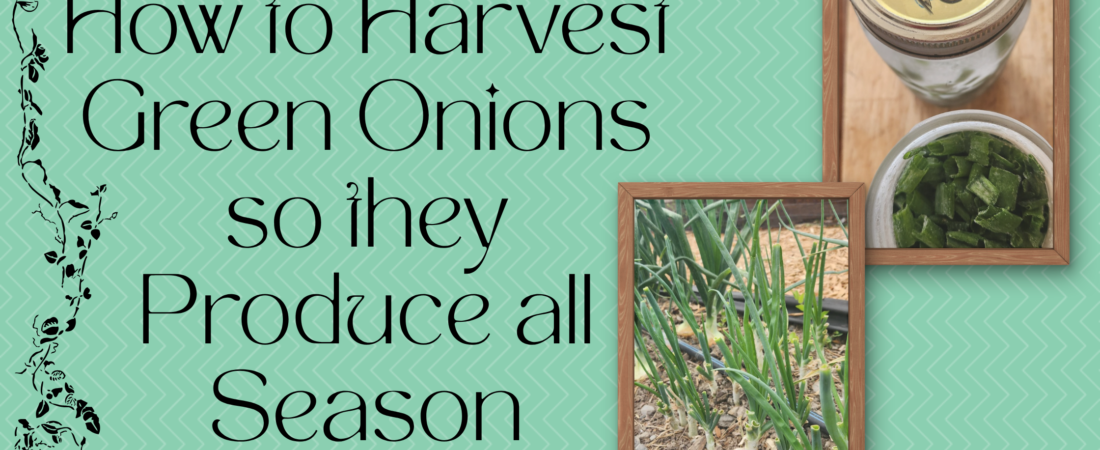
Green onions are a versatile, healthy, and easy way to add nutrition to your diet. They can be added to salads, as a garnish on almost any food, in soups, dips, sandwiches, tacos, marinades, and compound butter. They add a ton of vitamins, minerals, and antioxidants and take little work to grow, harvest, and store. Green onions are low in calories, but aid in digestion, eye health, heart health, immune support, and bone health. Some studies even suggest that they can help reduce inflammation.
So, how do you grow and harvest green onions?
Planting Green Onions
Onions can be purchased in seeds or sets and while the packaging may show full-grown onions rather than green onions, these plants can be grown in a way they produce green onions, too. Seeds take longer to grow and, honestly, I’ve had less luck with them actually starting. For these reasons, I start with sets- though they cost a little bit more.
Green onions can be grown from almost any variety of onion. We’ve tried green onions from yellow, white, and red onion sets. However, we like the milder flavor of green onions grown from white onion sets.
Once you have your sets and your garden is prepared, green onions are easy.
First, dig a small hole for your first green onion set, just large enough that the set fits inside. Place the set in the hole root side down. If any stalks are already growing, be sure to place those upright and above the soil. Cover the set and pack soil firmly around it.
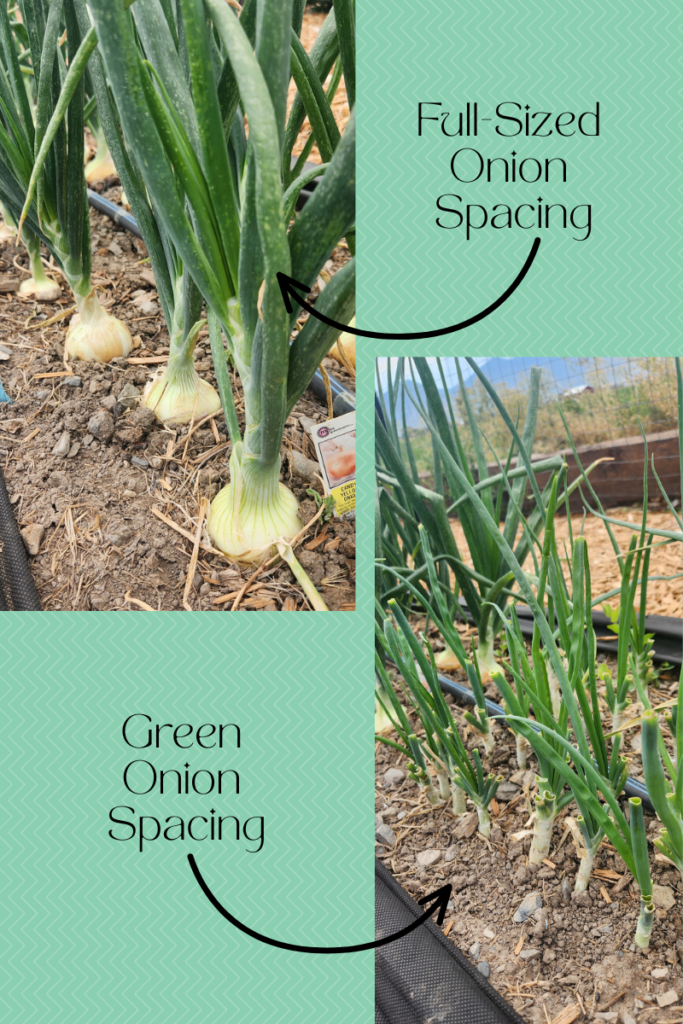
Sets should be planted 2-3 inches apart, down your row or garden bed. In my garden, green onions are grown in a double row- we plant two rows of sets in our green onion row, since they can be placed so close together.
Our family of five plants about 20 green onion sets and this gives us more than enough for the entire year.
Planting this way saves space, but will not allow the onion to grow underground. If you want full onions as well, it’s best to plant separate sets in another spot in the garden. These will need to be planted 4-6 inches apart and 1-2 inches deep. For full-sized onions, you will not cut the green onions on the top, as this will force the plant to put all its energy into growing stems, rather than the onion below ground. In the pictures below, you can see the difference between spacing for green onions and full-sized onions.
Once your sets are planted, water regularly but ensure that they are not sitting in puddles, as this can produce rot.
When to Harvest Green Onions
When your plant has stalks reaching 6-12 inches tall, it’s time to harvest your green onions. Stalks should be bright green, grow in groups above the set, and be about 1/4 in. thick. As with other plants, green onions will be more tender when they are smaller, but can be used if they are up to 1/2 in. thick.
If you are growing from sets, your first harvest should be about 30-60 days after planting.
How to Harvest Green Onions
One option for harvesting green onions (the one most stores carry) is to pull the entire plant up when you have enough stalks growing. This allows your to use almost the entire plant, but only gives you a single harvest. Once the plants are up, you will need to re-plant, wait, and harvest again.
However, if you harvest just the stalks, green onions will continue to grow all season, allowing weekly harvests from a single plant and helping you to build up your storage for the year.
Step 1: Find the Smallest Stalk(s)
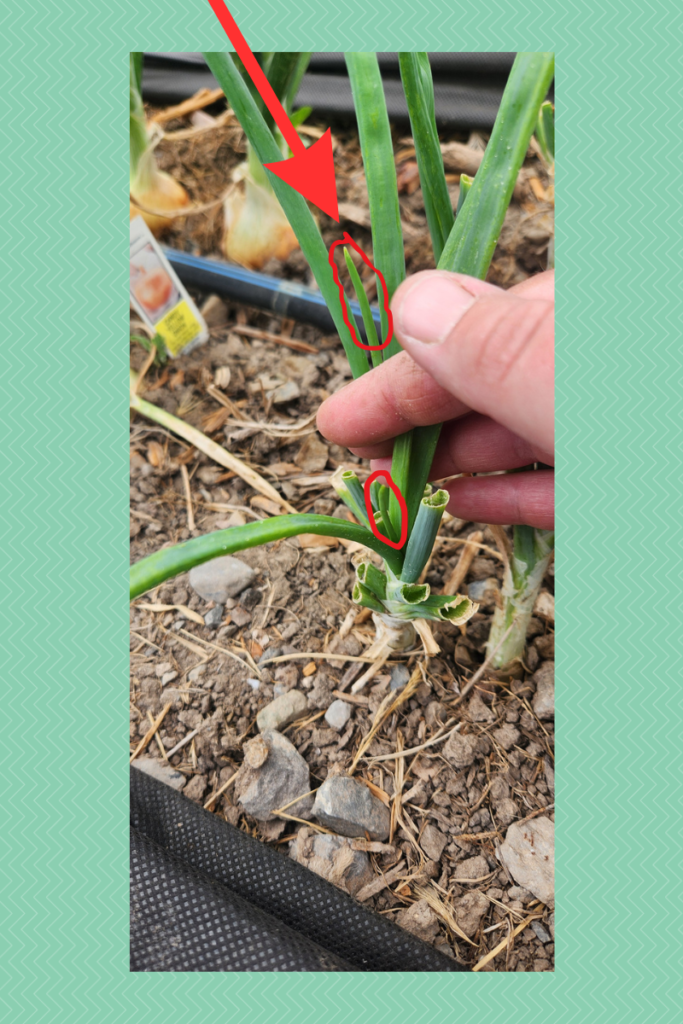
First, look at a single green onion plant, which should have several stalks growing from a single set. Each of these stalks will be a different height and thickness. Find the smallest stalk. This is the one that has started to grow last in the bunch. It will be thin, pointy, and usually towards the center of the plant. Some plants may have two of these. These stalks are the key to allowing the green onions to grow again, allowing for multiple harvests. Do not cut the smallest stalk.
In the image below, I have circled the two newest stalks. Below them, you can also see the stalks I harvested the week before-the short, cut, not-pointy ones at the bottom of the plant.
Step 2: Harvest the Green Onion-Bigger Stalks Only
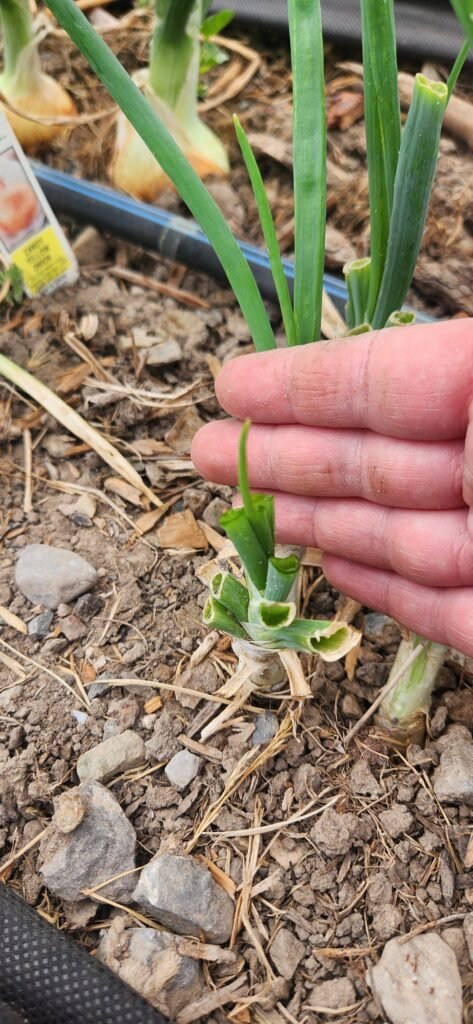
Avoiding the new, too-short, pointy stalks, cut the bigger stalks around them about 1 inch above the ground. You can use a knife, pruning shears, or scissors. I find that scissors give me more control and allow me to cut the bigger stalks without harming the little ones. Plus, they are easy to find.
Below you can see the freshly cut stalks, the older cut stalks, and the tiny new stalk left behind.
Step 3: Repeat with the Next Plant
Harvest this way until all of your green onion plants are harvested. This will force the plant to send energy into producing more stalks and, by next week, you will be ready to harvest again. Continue to water and weed as normal.
If you are also growing full onions do not harvest the stalks from those plants. Those stalks are needed to gather energy to grow the onion below ground. Harvesting them will not allow your onion to grow to full size.
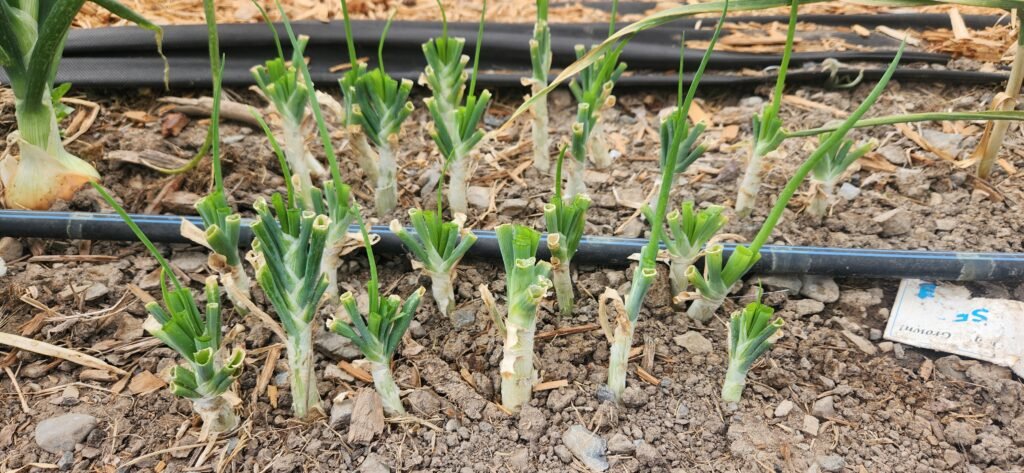
Below you can see all of my green onions are harvested and ready to grow more. In the left corner, you can see my full onions growing, with unharvested stalks.
Step 4: Wash and Store Your Green Onions
After harvest, green onions will wilt quickly. Take them inside, wash them with clean water, and allow them to dry on a paper towel. Next, prepare them for use or storage.
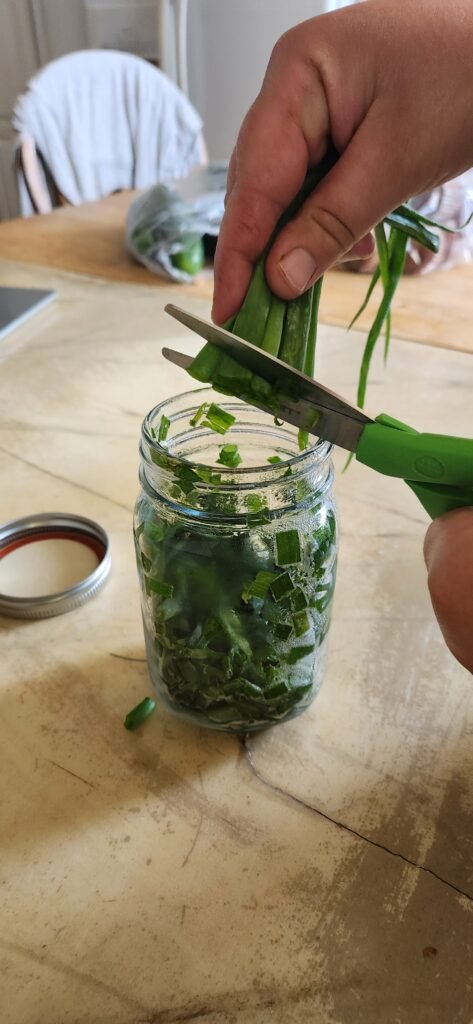
My green onions are stored in mason jars in the freezer. This allows me to use them all year round. I simply use the same scissors I used for harvesting to slice the green onions directly into the jar. This jar is then frozen (with a lid and ring), and kept until I need it. While cooking, I simply pull out my jar, scoop out the amount I need, and replace the rest in the freezer for later. Slicing them before freezing makes it quick and convenient when I just want a little extra flavor.
Below you can see some that I’ve already frozen (along with my little one’s help in labeling) this year.
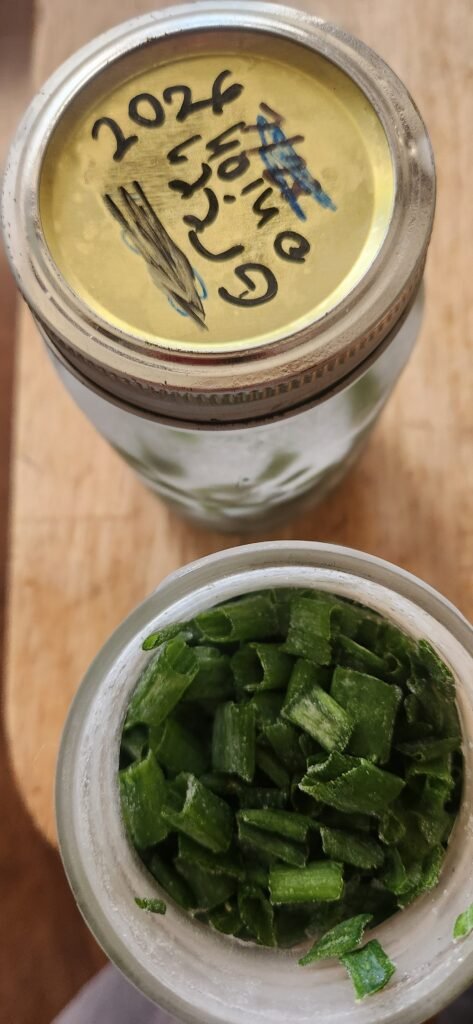
Freezing green onions preserves the flavor and is great for soups, ramen, or on top of baked potatoes. However, it does produce a slightly mushy consistency, making fresh green onions a better option for salads and fancy garnishes.
Green onions can also be dehydrated or freeze dried.
Step 5: Next Week
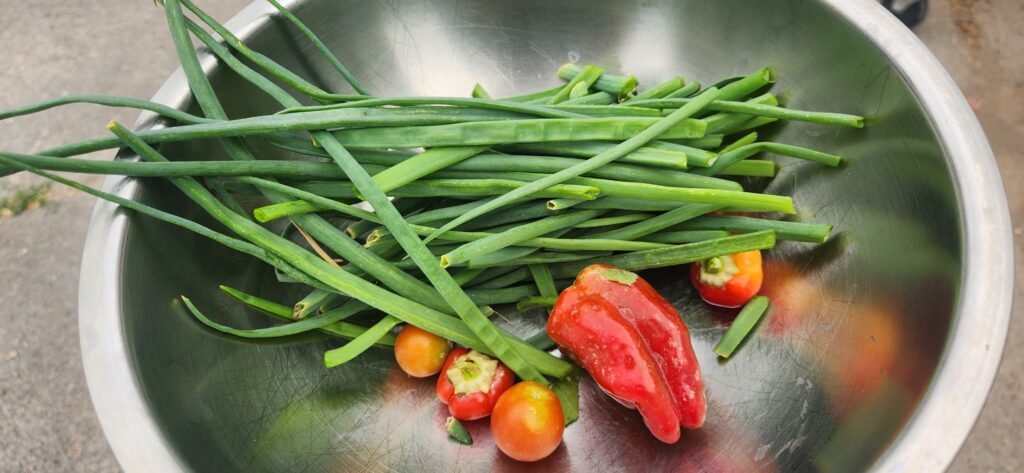
In about a week, we harvest green onions again, going through the whole process. Just be sure to keep the smallest stalk intact.
Step 6: Final Harvest
Our green onions grow from spring through fall. Just before the first frost, we like to clean up our garden so it can rest through winter. This means pulling out plants that will not produce during the winter.
During our final harvest, we pull the entire plant rather than cutting off single stalks. This allows us to use the entire plant, but only after it has produced all season.